Grassroots Venues Closing Threatens Festivals
53% of UK grassroots music venues made no profit in 2025. Here's why grassroots music venues closing is not just a venue crisis - it's a festival headliner shortage nobody is planning for.
The grassroots music venues crisis in the UK is being treated as a venue story. It isn't. The headline number from the Music Venue Trust's annual report landed in January and got the usual round of concern from the usual corners of the industry. But most of the conversation stopped at the venues themselves. Nobody is talking about what the grassroots music venues closing means for the stages those venues were feeding - or what it costs the festival industry when the talent pipeline runs dry.
The numbers, first
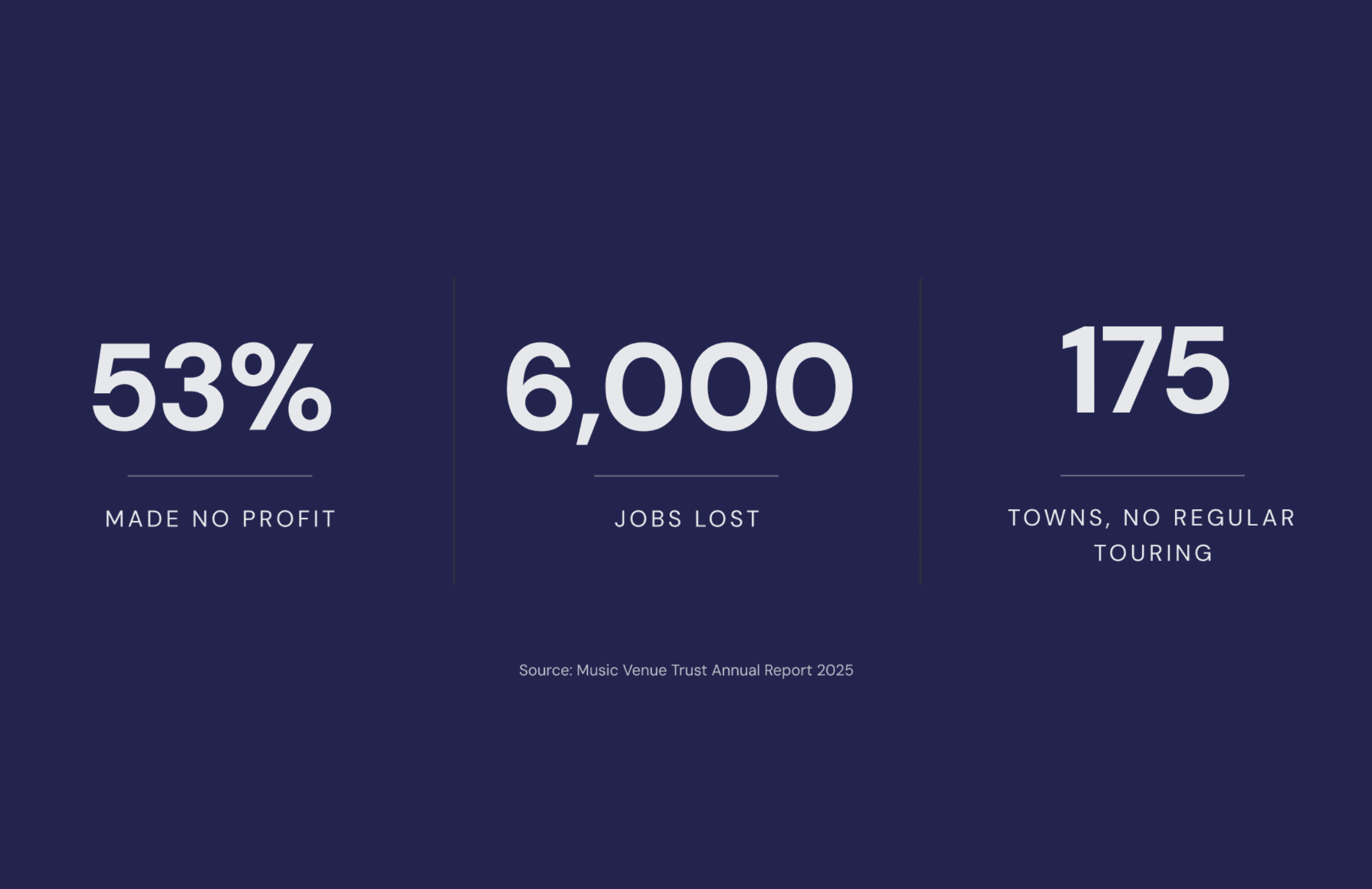
More than half (53%) of the UK's grassroots music venues showed no profit at all in 2025, with venues operating on average profit margins of just 2.5%. Government changes to National Insurance and business rates resulted in a loss of 6,000 jobs - a 19% contraction in the overall workforce.
In total, 30 grassroots music venues closed permanently last year. As a result, 175 towns and cities across the UK - home to an estimated 25 million people - no longer receive regular touring shows by professional artists, as the national touring circuit continues to shrink.
That last figure is the one worth sitting with. 175 towns. 25 million people. No regular professional touring.
Why this is a festival problem, not just a venue problem
Grassroots venues are not just places people go to watch music. They are where artists learn to perform in front of a live crowd, build a local following, and develop enough of a track record to move up to the next stage. In 2016, 19 artists headlined UK arenas for the first time. Of those, eleven had developed through the grassroots - they had played grassroots music venues, been promoted by independent promoters, and moved through the stages of music festivals.
The Arctic Monkeys made their debut at the Grapes pub in Sheffield. Amy Winehouse played her first show at Rayner's Hotel in Harrow. Adele played an early gig at the Buffalo Bar in Cardiff. The 1975 appeared at The Castle Hotel in Manchester.
These are not nostalgic footnotes. They are how the system works. Or how it worked.
The pipeline problem has a timeline
Here is where the festival industry has a specific, concrete problem. Top music venues are now booking two years ahead, locking in acts for 2027, and festivals are rushing to announce lineups earlier than ever. With a shortage of headliners and tours increasingly expensive to run, hot new artists are already being scouted out for 2026.
That forward booking pressure sits directly on top of a shrinking pool of artists who have had the development stages to reach it. The venues that gave those artists their first 50 shows, their first paying audience, their first experience of holding a room - those venues are closing at a rate that has no precedent in the data the Music Venue Trust has been collecting.
The artists who will headline festivals in 2028 are playing smaller venues right now. Some of those venues will not be there next year.
The NI and business rates problem is not going away
The Music Venue Trust cited employer National Insurance increases as the principal driver of job losses, while the recent increase in business rates has also proven devastating.
These are structural cost increases, not temporary shocks. The venues that survived 2025 on a 2.5% average margin have no buffer for another year of the same conditions. The majority of grassroots music venues are now one financial shock away from crisis.
What the grassroots levy was supposed to fix
There is a partial solution on the table. The grassroots levy is a voluntary scheme under which large concerts at stadiums and arenas reinvest a portion of gross revenue back into smaller venues. The Music Venue Trust warned that if voluntary industry action does not deliver by June 2026, the Government must legislate. That deadline is now.
The levy exists because the logic is hard to argue with. Without the talent pipeline that comes through smaller venues across the UK, there are no future arena headliners. The top of the industry is, in the most literal sense, dependent on the bottom remaining functional.
But the levy is voluntary. And voluntary tends to mean slow.
The practical question for festival directors
If you are booking acts for 2027 and 2028, the question is not abstract. A contracted touring circuit means fewer artists have had the opportunity to develop the stage presence, audience, and booking history that makes them a credible mid-bill or headliner prospect. The shortage of bankable headliners that already caused Wireless 2026 to anchor its entire lineup on a single artist is not going to ease on its own.
For festival directors managing tightening budgets and a shrinking headliner pool, understanding this connection is now a practical financial planning issue, not just an industry concern.
Where financial visibility fits in
The venues crisis and the festival headliner shortage are structural problems that need structural solutions - the levy, government support, industry reform. None of that is fast.
What festival directors can control in the meantime is how clearly they can see their own numbers. The festivals that will survive the next three years of tightening headliner supply, rising costs, and shrinking margins are not necessarily the biggest ones. They are the ones making better-informed decisions, earlier.
That is what Eventwise is built for - financial management software designed specifically for festivals and live events, so that the people running them can see the full picture before the invoice arrives, not after.
If you are planning events for 2026 and beyond, you can find out more here.
References
Music Venue Trust Annual Report 2025 - https://www.musicvenuetrust.com/2026/01/music-venue-trust-annual-report-2025/
NME: Over half of UK grassroots venues made no profit in 2025 - https://www.nme.com/news/music/music-venue-trust-report-2025-half-grassroots-no-profit-6000-jobs-lost-3924588
Jazzwise: Music Venue Trust Annual Report warns sector remains financially fragile - https://www.jazzwise.com/news/article/music-venue-trust-annual-report-warns-grassroots-music-venues-remain-financially-fragile
Event Industry News: Music Venue Trust Annual Report 2025 - https://www.eventindustrynews.com/news/music-venue-trust-annual-report-2025-warns-grassroots-sector-remains-financially-fragile
The Guardian / LBC: Grassroots levy and June 2026 deadline - https://www.lbc.co.uk/article/half-grassroots-music-venues-did-not-make-money-5HjdR6F_2/
Music Venue Trust written evidence to Parliament: grassroots to arena pipeline data - https://committees.parliament.uk/writtenevidence/129613/html/
The Big Issue: Arena venues and the talent pipeline - https://www.bigissue.com/culture/music/venue-watch-arenas-grassroots-music-mvt-ao-manchester/
The Guardian / inkl: UK festivals face tough year, headliner shortage, two-year booking windows - https://www.inkl.com/news/uk-festivals-face-really-tough-year-due-to-fewer-headline-acts-and-rising-costs


